
Quick Summary
Proof of delivery (POD) is evidence that goods were received by the right person at the right place and time. It usually takes the form of a signature, a stamp or an electronic record, and it protects both the sender and the receiver when questions come up.
What Is Proof of Delivery?
Proof of delivery, often shortened to POD, is the record that closes a delivery. It confirms that the goods reached the customer and that someone accepted them. For years the POD was a signed or stamped delivery note. Today many teams capture the same evidence on a mobile device, which is called electronic proof of delivery, or ePOD. [what is electronic proof of delivery]
The meaning of POD in logistics comes down to one question: did this delivery arrive, who accepted it and when?
Why Proof of Delivery Matters
Evidence When a Delivery Is Questioned
Customers sometimes say an order never arrived, or arrived damaged or short. A proof of delivery shows what was delivered and who accepted it. Without one, your team is left with one person’s word against another’s.
Billing and Invoicing
Many businesses confirm a delivery before they invoice. If the proof of delivery is late or missing, billing waits too. A fast, reliable POD helps cash flow move.
Accountability at Every Handover
A POD creates a clear record of each handover between the sender, the driver and the receiver. When something goes wrong, the record shows where.
Customer Service and Trust
When a customer asks where an order is, your team can answer with facts. A clear record builds trust and shortens difficult conversations.
What Counts as Proof of Delivery
Several kinds of evidence can serve as proof of delivery:
- A signed delivery note. The recipient signs a printed note listing the delivered items.
- A stamped note. The recipient’s company stamp is added, often together with a signature.
- A photo. A picture of the goods or the drop-off point, which is useful when no one is there to sign.
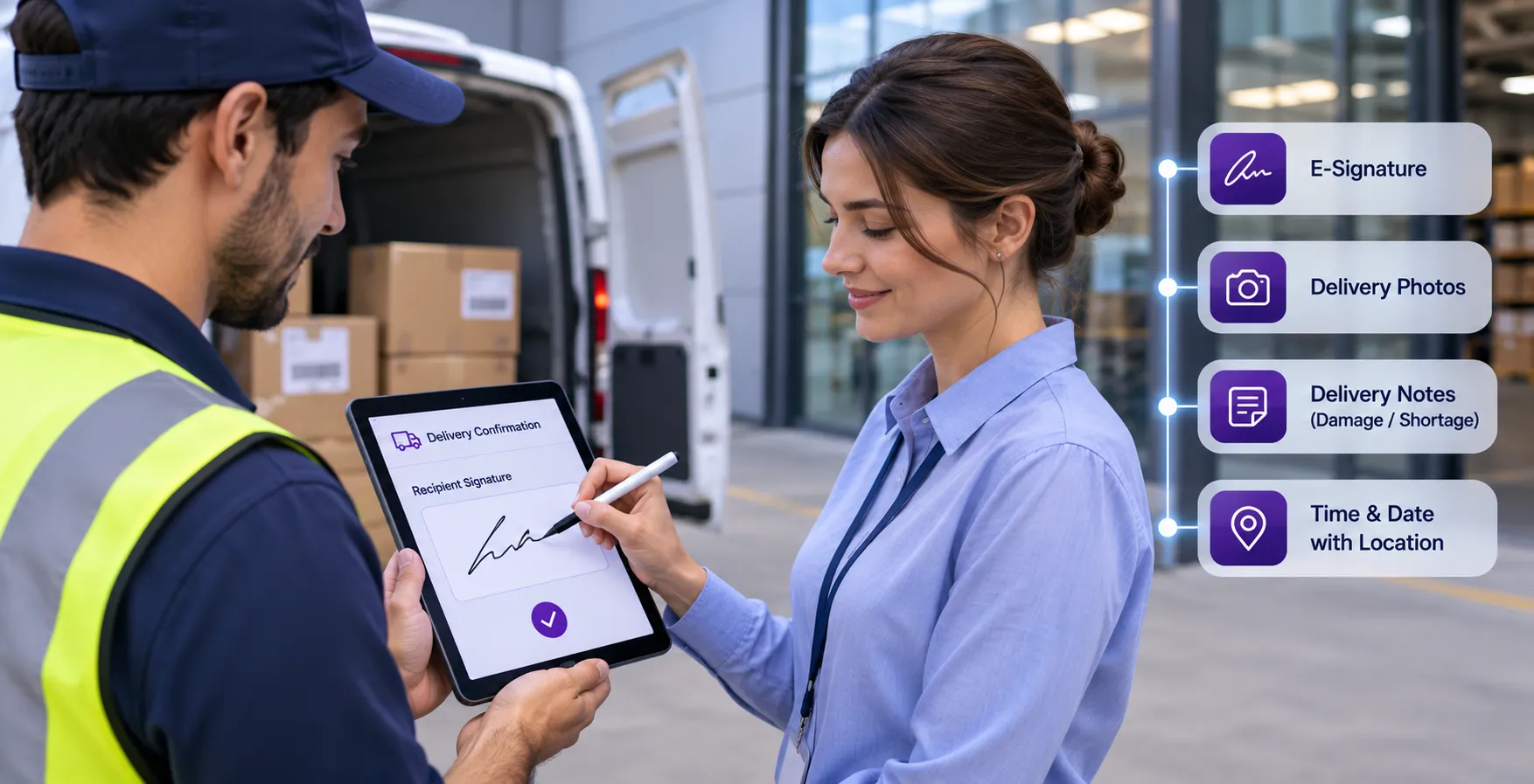
- An electronic signature with a time record. The recipient signs on a mobile device, and the system records the date and time.
- The recipient’s name and notes. Who accepted the goods and comments on condition or shortages.
What your business needs depends on your customer contracts, your industry, and your country. Check what your customers and your legal team expect.
What a Proof of Delivery Record Usually Contains
A good record includes:
- an order or delivery reference
- the recipient’s name and signature
- the date and time of delivery
- the items and quantities delivered
- notes on condition, damage, or shortages
- photos, where they are used
Who Uses Proof of Delivery
Any business that moves goods to customers uses some form of proof of delivery. That includes distributors, wholesalers, retailers, couriers, field service teams, and manufacturers. Inside each business, several teams rely on it: drivers capture it, dispatchers and customer service look it up, and finance uses it to support invoicing.
The Proof of Delivery Process in Steps
- The order is confirmed, and the delivery is scheduled.
- The goods are picked, packed, and loaded, with a packing slip or delivery note.
- The driver delivers to the customer.
- The customer checks the goods and accepts them.
- The proof is captured as a signature, a stamp, photos, or notes.
- The record reaches the office, and the delivery is confirmed for billing and records.
A Simple Example
A distributor delivers ten cartons to a customer. The driver counts the cartons, notes that one is damaged, and asks the customer to sign for nine accepted cartons. The note records the problem, and the office uses it to arrange a replacement. Without a record made at the door, the damage would be hard to prove. This is an illustration, not a customer story.
Proof of Delivery vs Delivery Note vs Bill of Lading
These three documents are often confused:
| Document | What it is | Who uses it |
|---|---|---|
| Delivery note | Lists the goods being delivered | Sender and receiver |
| Proof of delivery | Confirms the goods arrived and were accepted | Sender, carrier, receiver, finance |
| Bill of lading | A transport document issued by the carrier that acknowledges the goods were received for shipment | Shipper, carrier, receiver |
A delivery note often becomes the proof of delivery once the recipient signs it. A bill of lading is a different document that covers the shipment itself.
Proof of Delivery by Industry
The need is the same everywhere, but the details change:
- Retail and e-commerce. Home and store deliveries need a quick confirmation, and customers expect updates.
- Healthcare and pharmacy. Time-sensitive items benefit from a record of who accepted them and when.
- Logistics and distribution. Many drops a day make a fast, consistent record essential.
- Construction and public sector. Materials and supplies are delivered to sites and offices, where photos and notes help show what arrived and where.
Best Practices for Capturing Proof of Delivery
- Capture the proof at the door, not later.
- Record the recipient’s printed name as well as the signature.
- Note any damage or shortage before the customer signs.
- Take a photo when no one is available to sign, if your policy allows it.
- Use one standard format for every delivery.
- Make sure the record reaches the office the same day.
- Store records where they are easy to search.
Paper vs Electronic Proof of Delivery
Paper proof of delivery is simple to start but easy to lose, damage, or misread. Someone also has to file it or type it into a system. Electronic proof of delivery captures the same evidence on a phone or tablet, stores it against the order, and makes it available to the office straight away. [electronic vs paper proof of delivery]
Common Proof of Delivery Problems
Lost or Damaged Notes
Paper notes travel in vehicles and can get wet, torn, or misplaced. Capture the record digitally at the door, or keep a copy in a safe place.
Unclear Signatures
A scribble does not show who accepted the delivery. Ask for a printed name as well, or record the recipient’s name in a note.
Missing Details
Notes with no date, time, or order reference are hard to use later. Use a standard format and a checklist for drivers.
Slow Return to the Office
If the paper only arrives days later, billing and customer queries wait. A system that sends the record straight away avoids the delay.
How Electronic Proof of Delivery Helps
KAISPE KPoD Proof of Delivery is an electronic proof of delivery solution with a mobile app and a management portal. Drivers capture e-signatures, photos with time, date, and location stamps, and customer notes on Android or iOS, and the app keeps working offline. Your team sees the records in real time, and the data can sync with your ERP. You can try KPoD on the free plan.
Conclusion
Proof of delivery is a simple idea with a big effect. It shows what was delivered, who accepted it, and when, and it supports billing, customer service, and fewer disputes.
If your team still relies on paper, consider how much time goes into chasing, filing, and retyping it. Then explore how electronic proof of delivery could simplify the process.
FAQs
Proof of delivery (POD) is evidence that goods were received by the right person at the right place and time. It is usually a signature, a stamp, or an electronic record, and it often includes the date, time, and delivery details.
In logistics, POD stands for proof of delivery. It is the record that confirms a shipment reached its destination and that someone accepted it.
The most common are a signed or stamped delivery note and a signed receipt. Many teams also use photos and an electronic signature with a time record. Which documents apply depends on your contracts and your industry.
It depends on your customer contracts, your industry, and your country. Many businesses use a signature, but some also accept photos or other evidence. Check the requirements with your legal or compliance team.
A bill of lading is a transport document issued by the carrier that acknowledges the goods were received for shipment. Proof of delivery is the record that the goods arrived and were accepted at the destination. The two documents serve different purposes.
Retention periods depend on your contracts, your industry, and local tax or legal rules. Ask your legal or finance team for the period that applies to your business, and keep records somewhere they are easy to find.