

Quick Summary
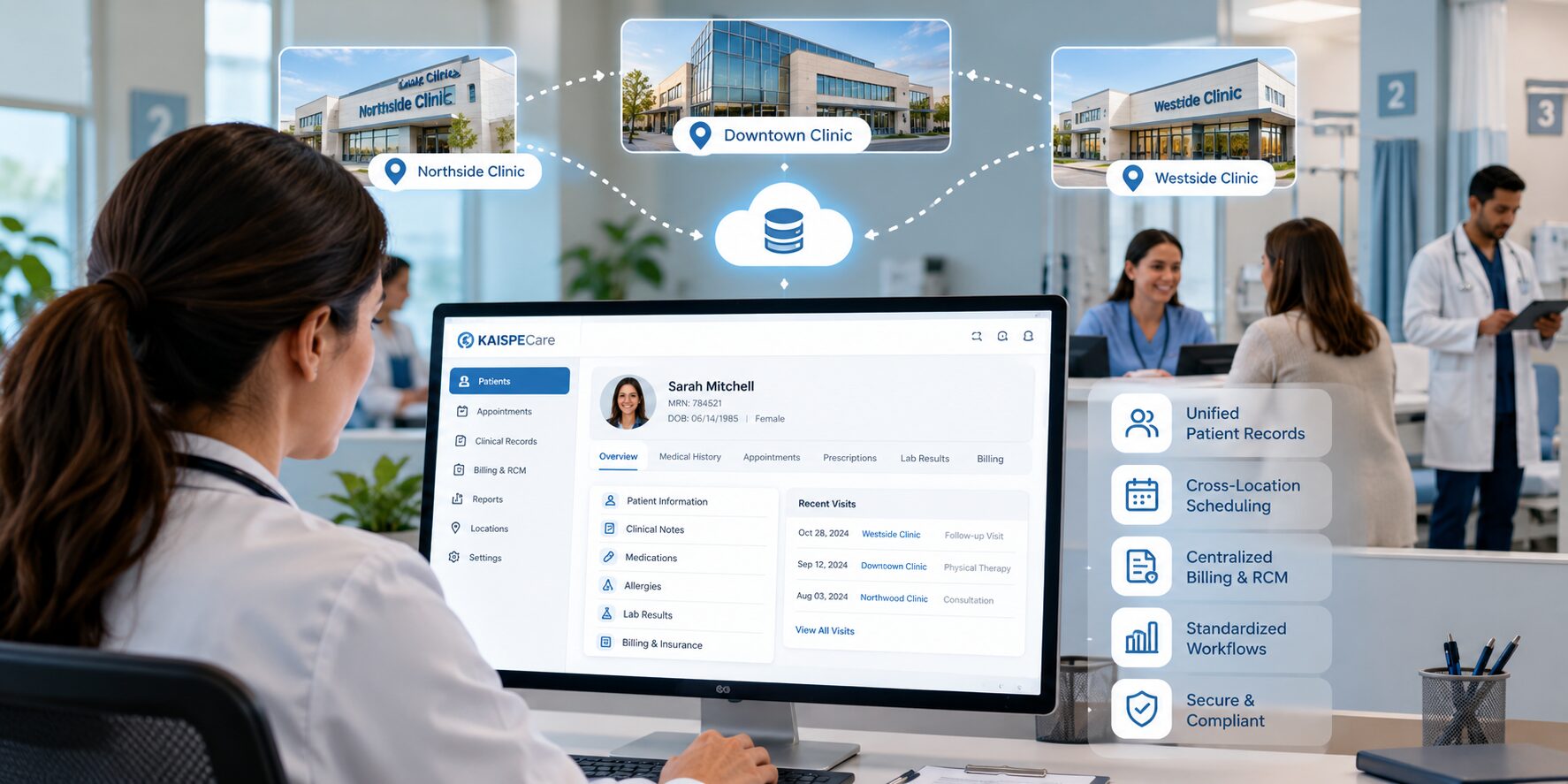
In today’s world, fragmented patient data and having multiple platforms to manage patients create chaos and an unproductive practice. In this guide, we’ll break down the risks of fragmented records and discuss how tools like KAISPECare can help unify data across all branches of the organization. It will show benefits clinically, financially, and even in administration.
Introduction
Mastering Multi-Location Clinic Management is the defining challenge for medical groups transitioning from a single successful practice into a scalable regional network. If your healthcare organization relies on disjointed systems, localized servers, or manual chart transfers between facilities, you are actively degrading the patient experience and increasing your exposure to compliance risks. In the modern healthcare landscape, providers cannot afford blind spots regarding patient history or billing status simply because a patient visited a different branch location last month.
Scaling a medical practice introduces immense operational friction. Traditional administrative setups simply cannot process the heavy volume of cross-facility scheduling, billing, and clinical documentation required to maintain a unified standard of care. The transition from reactive troubleshooting to proactive healthcare data management requires a fundamental shift in how your clinical directors and administrative staff access information.
Unifying your digital infrastructure is no longer an optional IT upgrade; it is a clinical necessity for delivering safe, consistent, and profitable care.
The Core Challenges of Multi-Location Clinic Management
The first step towards making an improvement at the enterprise level is understanding the current system that’s implemented and noticing how bottlenecks are created. Many times, these problems and bottlenecks are created because software vendors are disconnected, and localized protocols fail to scale properly.
-
EHR Fragmentation and Interoperability Gaps
One of the most common complexities that enterprises face is not having a single place to access all patient records. An example of this is when a patient wants to schedule a follow-up with the doctor; the attendant has to access all their previous records. This includes doctor’s notes, lab reports, and all the previous medication the patient has been taking. Without any centralized patient data management system, practitioners face blind spots. This increases the risk of repetitive testing and even adverse drug events.
-
Revenue Cycle Management Leaks
When the internal administrative vulnerabilities increase, the days in accounts receivable also inflate. When each clinic location operates its own localized schedule and billing ledger, the centralized back office cannot accurately access information. They can’t track Relative Value Units, manage provider workloads, or forecast ROI. Effective practice data management requires a unified calendar and a comprehensive unified financial dashboard to allocate resources properly. To overcome these structural hurdles, leading healthcare executives analyze specific outpatient clinic use cases. These help in transitioning from scattered records to a connected ecosystem and drastically reduce front-end claim rejections.
Why Centralizing Data Transforms Multi-Location Clinic Management
In a high-velocity and Value-Based Care environment, relying on an old database to support Multi-Location Clinic Management is risky and obsolete.
-
Patient Data Management
The end result of consolidated healthcare data is to make sure that the experience of the patient is the same everywhere in the physical setting. When the clinical staff utilizes the clinic software at all the different locations, they create a Master Patient Index so that the whole medical record goes with the patient. This empowers physicians to make rapid, evidence-based decisions based on historical data rather than being based on just memory during triage.
-
Standardizing Clinic Management Software Workflows
In an effective digital ecosystem, the standardization of operations is highly emphasized for all tax IDs and physical sites. In order to keep the workflow uniform across all sites, there should be no variation in intake processes, prior authorization requirements, and application of the billing codes. Plus, modern clinical management systems support these standardized processes uniformly. When a registrar fails to verify the eligibility of a patient in real time, the software automatically flags it. This neutralizes the threat of denied insurance claims and ensures strict payer compliance.
Impact On Real-World Clinics
The gravity of the situation can be determined when one considers an example of a regional network of physical therapy services which consists of eight clinics in three cities. Before the organization improved its enterprise architecture, it was facing a phenomenal claim rejection rate of 18% because of outdated ICD-10 codes and non-verified payer policies.
The Hidden Cost of Claim Denials
According to a comprehensive industry analysis by the Medical Group Management Association (MGMA), the average cost to rework a single denied claim is approximately 25 dollars. This severely drains operational margins. In this particular network, the lack of centralized healthcare data oversight meant the central billing office was constantly playing catch-up just to gather pieces of the ledger from eight different databases and software.
Reclaiming Revenue and Reducing Burnout
Upon implementing a unified platform for Multi-Location Clinic Management, the network unified its billing workflows and standardized its digital intake protocols. A recent report from the Office of the National Coordinator for Health Information Technology (ONC) reveals that interoperable health IT massively reduces administrative redundancies. It also improves care coordination by utilizing centralized multi-location practice management tools. As a result of these practices, this therapy network reduced its claim denial rate to just 4 percent within two quarters- and ultimately recovered hundreds of thousands of dollars in lost revenue.
Unifying Operations with KAISPECare
These modernized systems are usually difficult for healthcare administrators to implement without interfering with clinical schedules or violating compliance requirements. KAISPECare is a top-of-the-line healthcare IT solution designed to handle the tough architectural problems encountered by healthcare industry professionals dealing with large amounts of clinical data.
Cloud-Native Security and Control
Implementation of KAISPECare is an ideal approach to ensure the best possible Multi-Location Clinic Management. The system takes care of all the processes starting from registering patients up until submission of claims through the clearinghouse, functioning within the highly secure environment of the Microsoft Azure cloud infrastructure. Through this integration, the system provides a single source of truth that can be accessed only by authorized individuals.
Intelligent Clinical Triage and Ambient Documentation
Rather than depending on front-desk receptionists to receive hundreds of phone calls from patients in different time zones, the automated process utilizes patient portals that are secure for handling complex scheduling algorithms. Patients can easily see provider availability at all locations and fill out online intake forms before coming. You can implement a comprehensive clinical AI solution to assist with symptom checking and suggest optimal appointment times based on historical data.
Centralized Billing and Automated Clinical Records
There is an efficient digital solution that will ensure separation of duties while providing an integrated view of the patient at all times. Today’s digital solutions document every update to the clinical record, e-prescription, and billing changes in real time. Those organizations that adopt such measures will be in perfect compliance with the standards set out by HIMSS.
Core Features for Multi-Branch Clinics
The platform provides a powerful suite of advanced outpatient clinic software features designed to lock down your multi-branch operations:
- Hayan AI Copilot: This built-in intelligent assistant instantly auto-generates visit summaries in PDF format. It also checks for complex drug-to-drug interactions and flags risk factors for chronic conditions.
- Role-Based Access Controls: Securely manage doctors and care teams across multiple locations with strictly defined roles. Ensures compliance with the Health Insurance Portability and Accountability Act.
- Automated RCM Workflows: The system detects missing consent forms and then auto-applies correct billing modifiers across the entire enterprise.
Interoperability and Ecosystem Integrations
An effective enterprise platform should be able to converse smoothly with the rest of your technical environment. This can be done by using integrations with your healthcare system that can help your clinics communicate with external insurance payers’ systems in order to conduct an online eligibility determination check. Additionally, integration with external labs with the help of HL7 standards will enable your doctors to send test orders and tie their results to your EMR.
Unifying your software stack effectively eliminates the informational silos that plague rapidly expanding medical groups, defining the true essence of modern Multi-Location Clinic Management.
Conclusion
Do not let disconnected systems and manual vulnerabilities limit your organization’s growth potential. KAISPECare provides the AI-powered tools and a unified patient data management database you need to deliver world-class care across every single location. Visit KAISPECare today to discover how our enterprise healthcare technologies can scale your medical practice.

